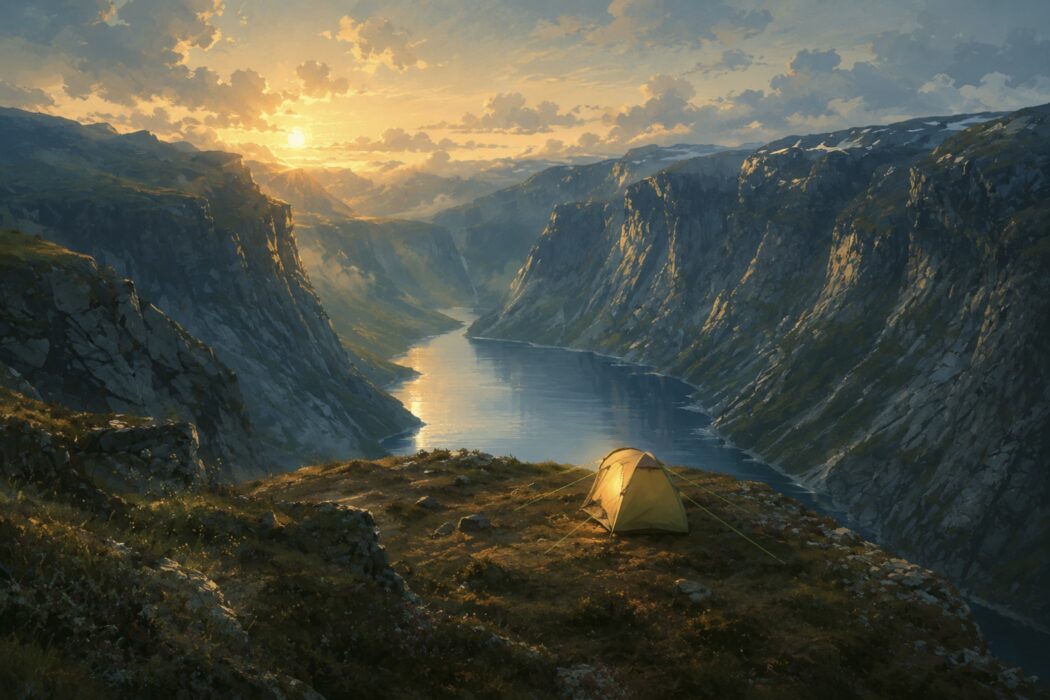
There are few countries that make sleeping in the great outdoors as simple as it arguably should be. Norway is one of them. Under the Outdoor Recreation Act of 1957, the country enshrined something called the Allemannsretten into law. Literally translating to ‘everyone’s right’, it means you can pitch a tent on almost any uncultivated land in the country, including privately owned stretches of forest, mountain and coastline, without paying a Krone or asking a soul. The principle is straightforward, Norway’s landscape belongs to everyone who sets foot on it, provided they treat it accordingly. Now wouldn’t that be a novel global approach.
That last part, the ‘treat it accordingly’, is where most first-timers come unstuck. The freedom is genuine, but it isn’t unconditional. Campers need to stay at least 150 metres from the nearest inhabited home. If you want to remain in the same spot for more than two nights, you’re expected to ask the landowner’s permission. And while the right covers forests, bogs, mountains and open shoreline, it stops at cultivated ground. This means Ploughed fields, gardens and fenced-off land are out of bounds. Try to camp on any of those and you’re technically trespassing, which in rural Norway tends to result in a polite but firm request to move on.
The smarter approach is to read the landscape before you unroll the sleeping bag. If the ground looks worked, even if nothing’s growing, it’s off limits. If a fence exists, the same applies. When in doubt, ask locally. Norwegians tend to be generous with their land and direct with their advice.
Fire is the other area where the rules tighten considerably. Between 15 April and 15 September, Norway bans campfires in nature to prevent forest fires, a regulation that carries real legal weight. You may light one in genuinely low-risk areas, beside the sea, on approved sites, but you are personally liable for anything that goes wrong.
Wildlife, too, deserves more distance than most visitors give it. The instinct to approach or, worse, feed animals is understandable but counterproductive. Human food disrupts their diet, and proximity pushes them off the land they rely on. The general rule is the same one that applies to most things worth admiring: look, appreciate, and leave it alone.
Norway’s Camping Code of Conduct rounds out the etiquette neatly: take everything you carried in back out with you. Every wrapper, every bottle, every trace. It sounds obvious. It’s remarkable how often it isn’t respected.
On the practical side, Norwegian weather has a well-earned reputation for changing its mind. Layering is non-negotiable. Lightweight pieces you can add or shed as the day turns, waterproofs that actually work, and sun protection for the hours when the cloud breaks. In the north, particularly between late May and the end of July, you’ll also contend with the midnight sun. Twenty-four hours of unbroken daylight that is magnificent to witness and deeply unhelpful for sleep. A decent sleep mask is essential, a blackout tent even better, unless you’re the rare traveller who can drift off at two in the morning with the sun streaming directly onto your face.
Connectivity is worth a moment’s thought, too. Much of rural Norway sits beyond a reliable mobile signal, which is part of its appeal but does make navigation harder. Download offline maps before you leave. Carry paper ones as backup. Remember, your phone is one river crossing away from being an expensive paperweight, and a paper map has never run out of battery. If you have to check confidential comms while you’re out there, or a Wimbledon final, you already know the answer. A VPN routes your connection through a server in your home country so streaming platforms see you as a local user. You don’t need us to explain how one works, but you might need reminding to install it before you leave. Setting one up over a patchy Norwegian 3G signal in a fjord at dusk is probably not ideal.
One final, less glamorous point: tell someone where you’re going. Leave a rough itinerary with a friend, a partner, or a family member. Someone who will notice if you don’t check in. Wild camping in Norway is overwhelmingly safe, but the terrain is remote, the weather unpredictable, and mobile coverage patchy at best. If something goes wrong, the difference between a quick rescue and a prolonged one is usually whether anyone knew where to start looking.
Norway makes very few demands of the people who sleep on its land. Stay off cultivated ground. Keep your distance from homes. Leave no trace. Respect the fire ban. In return, it gives you the kind of freedom that most countries have either legislated away or never offered in the first place, the right to pitch a tent beside a fjord, on a mountainside, at the edge of a forest, and wake up somewhere that feels, for a few hours at least, entirely yours.