In 1638, the Venetian Republic opened the **Ridotto** inside the Palazzo Dandolo. It was winter, carnival season, and the state had grown tired of unregulated gambling spilling into the alleys and candlelit rooms of the city. So it did something very Venetian: it institutionalised vice and charged admission. Masks were permitted; disorder was not. High collars and tricorne hats softened the transaction. Money moved across baize tables beneath frescoed ceilings, watched over by the Republic. Gambling, in other words, became architecture.
The games themselves were already old. Dice have been found in Mesopotamia, carved from bone, Roman soldiers threw knucklebones between campaigns, Chinese tiles foreshadowed dominoes and, eventually, cards. Risk has always travelled well. It migrates with merchants and mercenaries, acquiring accents as it goes. What Venice formalised was not chance, but theatre — the choreography of it. The Ridotto imposed ritual: dress codes, rules, surveillance. It gave gambling a stage set.
From there, the idea spread not as contagion, but as refinement. The croupier’s hand hovers, no eye contact, even the felt holds its breath, and for a fraction of a second the table falls silent. We often describe gambling as entertainment and in some measure, excess. However historically civilisations have regulated it, disguised it, glorified it and condemned it in equal measure. Yet it persists, not because the games change, but because the ritual remains the same.
So when exactly did the flood gates open? In 1638, the Venetian Republic opened the Ridotto inside the Palazzo Dandolo, a discreet wing near the church of San Moisè that would quietly alter the architecture of vice as we know it in Europe. It was carnival season, and the state had grown weary of gambling seeping through alleyways and candlelit parlours beyond its control. So Venice did what Venice has always done best, it institutionalised vice and charged admission.
Il Ridotto, “the private wing”, became the West’s first public, legal mercantile casino. Public, that is, in theory. Entry was technically open but participation was not. A strict dress code demanded masks and tricorne hats, an aesthetic concession to carnival ritual that simultaneously enforced the existing social hierarchy. The stakes were high, the decorum higher. Those without means could observe the spectacle, but only nobles could afford to really play the casino games.
Money moved across baize tables beneath frescoed ceilings, supervised by the Republic itself. Gambling did not disappear from Venice’s shadows, it was elevated, contained, and of course the idea of taxing it wasn’t far away . In the Ridotto, wagering, for the first time, acquired walls.
The games themselves were already old. Dice have been found in Mesopotamia carved from bone. Roman soldiers threw knucklebones between campaigns. Chinese tiles foreshadowed dominoes and eventually, cards. Risk has always travelled well and migrated with merchants and mercenaries. What Venice formalised was not chance, but theatre, the choreography of it. The Ridotto imposed ritual: dress codes, rules, surveillance. It gave gambling a stage set.
In eighteenth-century France, aristocratic salons favoured games that rewarded calculation as much as luck. It was here that roulette took form. Legend has it that Blaise Pascal who, in attempting to build a perpetual motion machine, stumbled instead upon a geometry of risk. Roulette feels mathematical even when it resists mathematics; it suggests system where there is only probability. The green zero and later the American double zero, is less a design flourish than a philosophical reminder, the house has already calculated your optimism.
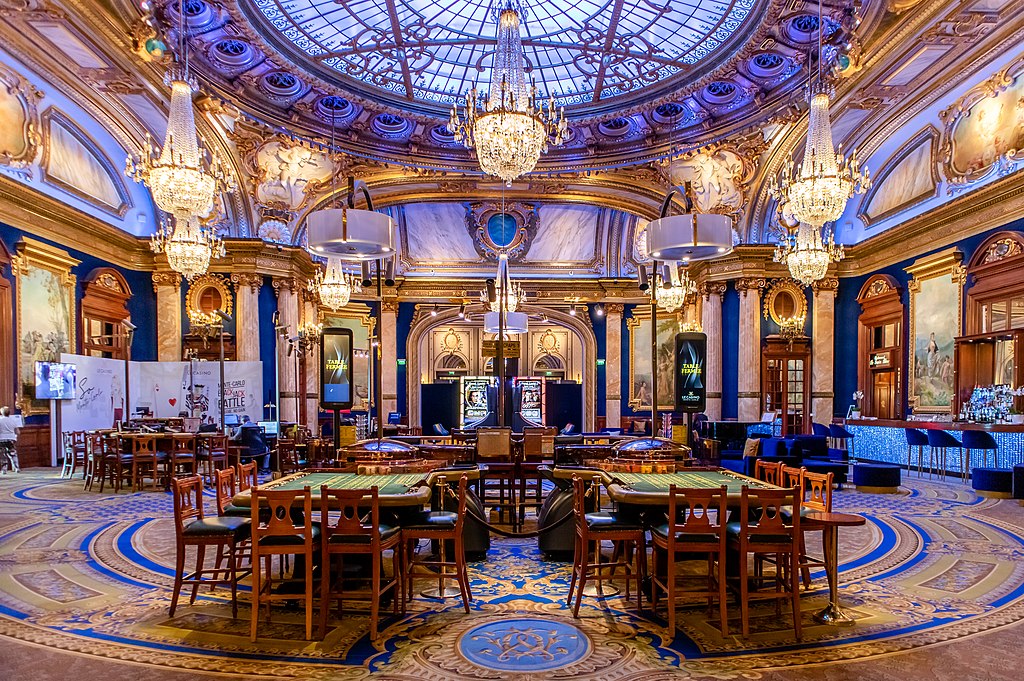
By the nineteenth century, gambling had crossed into spa towns and princely enclaves. Casino de Monte-Carlo did not merely offer tables, it offered redemption for a small principality on the brink of insolvency. Designed by Charles Garnier, architect of the Paris Opéra, the building was eminently beautiful. Marble staircases, gilded salons, Belle Époque optimism. Monte Carlo was trying to make risk glamorous. It attracted industrialists, Russian nobility, and those who wished to be mistaken for either. The croupier’s rake became infamous.
Across the Atlantic, the story hardened. In the mining towns of the American West, poker evolved not in ballrooms but in saloons. Fast, adaptable, psychologically acute. It required less architecture and more nerve than anything else. By the time Nevada legalised gambling in 1931, the United States had fused spectacle and survival into something uniquely modern. Las Vegas did not indeed invent gambling, it electrified it and bought it to the masses. Neon replaced candlelight. Air-conditioning replaced Mediterranean breeze. The Strip emerged as a corridor of engineered fantasy, culminating in properties such as the Bellagio, where fountains perform on schedule and the carpet is designed to disorient you just enough to keep you seated and inside.
Yet the games themselves remain stubbornly simple. Blackjack is still a dialogue between player and dealer. Baccarat still favours ritual over strategy. Roulette still spins with indifference. What changes is context. In Macau, baccarat became the lingua franca of high-stakes wealth transfer. In London’s members’ clubs, chemin de fer still carries a faint scent of Mayfair discretion. The felt absorbs centuries without complaint.
Today, of course, the casino is as likely to reside in a phone as in a palace. Algorithms shuffle cards faster than any human hand and live dealers broadcast from discreet studios to players far continents away. The intimacy has shifted from physical proximity to psychological immediacy. Yet even in its digital incarnation, gambling clings to ceremony, graphics recreate the wheel, avatars applaud improbable runs. We recreate the Ridotto in pixels.
What endures is not the machinery but the mood. Casinos are spaces where mathematics and wanton desire briefly agree to coexist. They are secular cathedrals to probability, places where we test the tension between control and surrender. The architecture, be it Venetian palace, Belle Époque salon, desert mega-resort, simply refracts that tension through the aesthetics of its era.
Dice, cards, wheels, these are props. The real continuity lies in the appetite for risk dressed as leisure. Venice masked it. Monte Carlo gilded it. Las Vegas amplified it. The smartphone democratised it. But the impulse is older than any chandelier and more durable than any neon sign.
The wheel spins. As it always has.