There are faster marathons than Paris. Flatter ones, too. If your ambition is purely numerical, personal bests, negative splits, the quiet tyranny of a Garmin, well then, other cities make a more convincing case. But none offer quite the same proposition as the Paris Marathon: 42.195 kilometres not simply of distance, but of full-frame cinematic immersion. Paris is, after all, one of the most culturally saturated cities on earth.
On the 12th of April 2026, nearly 60,000 runners will gather for the Schneider Electric Paris Marathon’s 49th edition, placing it among the largest marathons globally. What defines Paris is not so much its scale, but its composition. You’ll find elites chasing sub-2:10 times, sharing the same start line as amateurs, many of whom have never run the distance before. In fact, almost half the field this year are first-timers. This is not simply a race of performance, but of participation. Égalité.
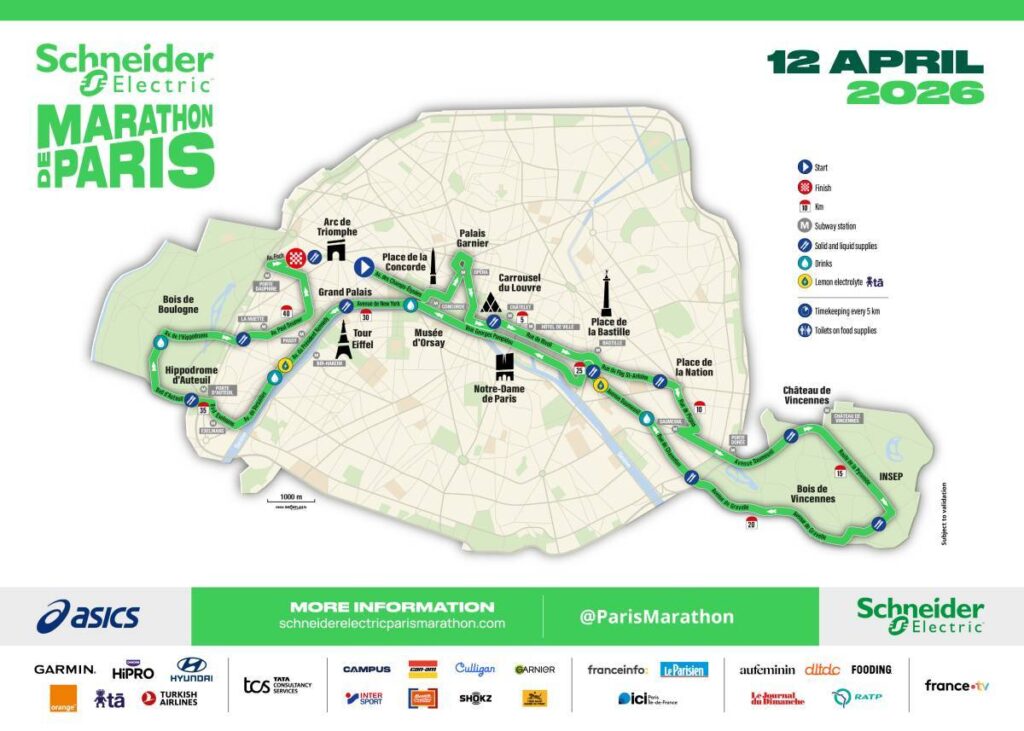
It begins on the Champs-Élysées, which always manages to maintain its sense of theatre. In the half-light of a Parisian morning, before the raucous crowds have quite found their voice, Paris does have a stillness. Arguably not for long. Thousands gather in loose corrals on race day, adjusting watches, stretching calves, sucking down nerves. There is a peculiar intimacy to it: each runner alone with their reasons for being there, yet collectively poised. Then there is the slow, tidal movement forward, followed by a slight downhill slope, which helps.
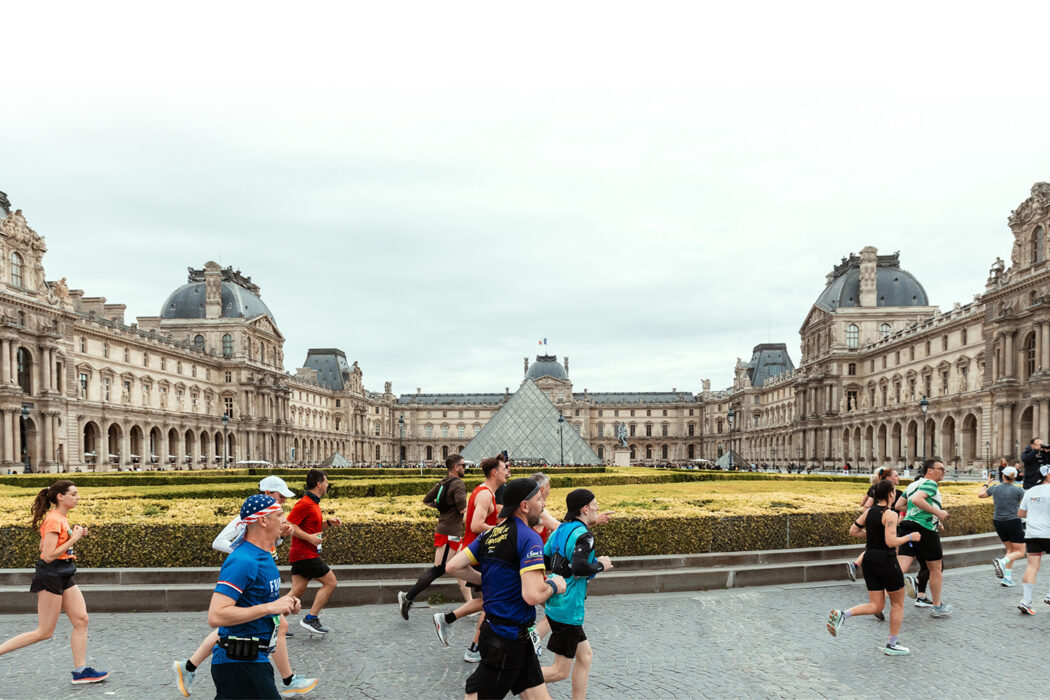
Of course, the early kilometres are forgiving. Wide boulevards, good sightlines, the gentle seduction of space. Runners sweep down towards the Place de la Concorde, where Louis XVI and Marie Antoinette met the guillotine, now marked by a tall Egyptian obelisk, before turning onto Rue de Rivoli. To the right, the Jardin des Tuileries flickers past. Then left onto Rue de la Paix, a loop around the ornate Place Vendôme and the Palais Garnier, and back down Avenue de l’Opéra. By the time the Louvre’s glass pyramids appear through the mass of the crowd, the legs are just warming up.
Rue de Rivoli becomes Rue Saint-Antoine as the route crosses into the Marais. One of the race’s better-kept secrets as a viewing spot, still lively but free of the start-line crush. The Gothic Tour Saint-Jacques appears, then the grand Hôtel de Ville on the right, the majestic Saint-Paul Saint-Louis Church just beyond. At the Place de la Bastille, the July Column rises above the junction. It’s a reminder that the city has previous form when it comes to upheaval. The course loops around the north side of the square before heading east.
The route pushes east along Rue du Faubourg Saint-Antoine into the 12th arrondissement (increasingly fashionable), as the shopfronts attest, before turning south at Rue de Reuilly and onto Avenue Daumesnil, the longest road in Paris. The crowds thin here. The fastest runners have pulled clear; the slower ones have settled into their rhythm. At Place Félix Eboué, the city begins to loosen its grip.
Shortly after the Km 12 marker, the route passes the Porte Dorée and the Palace of the Golden Gate. The 1931 exhibition hall is now home to the Museum of the History of Immigration. Then comes the Bois de Vincennes. Lake Daumesnil appears, then the Vincennes Zoo. Runners with eyes to spare might catch a glimpse of the Château de Vincennes, a fortified castle that dates to the 14th century. For a stretch of nearly ten kilometres, the city disappears. The tone shifts almost entirely. The race becomes quieter, more interior. It is here, often, that the first negotiations begin. The private recalibration between ambition and reality that every marathon eventually demands of its runners.
The route re-emerges onto Rue de Charenton, the halfway point, before looping back via a different section of Avenue Daumesnil and skirting the south side of Place de la Bastille. Along Boulevard Bourdon, the Bassin de l’Arsenal comes into view, and then the Seine. The legs know, by now, that the second half has begun.
This is where Paris earns its reputation. A ten-kilometre stretch along the river. Notre-Dame rises into view around Km 27, followed by the medieval towers of the Conciergerie. At Km 28, the Musée d’Orsay appears on the left, and across the water, the vast glass dome of the Grand Palais. The Eiffel Tower announces itself at Km 30 as a signal. And then, the tunnels.
They arrive without much ceremony. Dark, echoing interruptions that fracture the visual rhythm of the race and compress the senses. Sound folds in on itself. The light collapses. The body, already in negotiation with itself, can react a little unpredictably. The slopes emerging from the darkness add insult to injury. In a race defined by aesthetics, these are moments of genuine abrasion.
At Km 35, the route enters the Bois de Boulogne, two and a half times the size of Central Park, and in marathon terms, the hardest ask of the afternoon. The crowds thin almost immediately. Long, green corridors replace the city’s stone and glass. For those who have held something in reserve, the forest is manageable. For those who haven’t, it is where the race becomes brutally simple: one foot, then the other. It’s a negotiation with fatigue.
Emerging from the trees, the route continues along Avenue Paul Doumer towards the Place du Trocadéro, then up Avenue Raymond Poincaré, a soft left onto Avenue Hubert Germain, and finally a sharp right onto Avenue Foch. The finish line appears within 200 metres. The Arc de Triomphe rises just beyond it.
This year carries a subtle but meaningful shift in the event’s identity. With the 2025 field recording 51% first-time runners and 31% female participation (both records), and 2026 expected to push those figures further, Paris reflects a broader evolution in endurance sport. Less exclusive, more personal, more reflective of how the discipline has changed.
At the front, a tightly packed elite field suggests a race that may not chase records, but will reward tactical intelligence. Kinde Atanaw and Leul Gebresilase lead a men’s field defined by depth rather than dominance. Magdalyne Masai anchors a women’s race that feels increasingly competitive. Closer to home, Félix Bour and Emmanuel Roudolff-Levisse arrive for their Paris debuts with genuine intent. Not merely to perform, but to contend. It marks a quiet confidence in French distance running that feels rather overdue.
And then there is the most significant evolution: sustainability. The 2026 race eliminates single-use hydration entirely. No plastic bottles, no disposable cups. Just refill stations connected to the city’s water network and runners equipped with their own systems.
When the finish line on Avenue Foch finally arrives, the moment lands differently for everyone. Not because Paris is easy, but because it isn’t. Because it asks something beyond admiration. In the days that follow, the city resumes its usual Parisian rhythm. Cafés refill. Hectic traffic returns. The Champs-Élysées becomes, once again, a place of strolling rather than striving. And yet, for those who have run it, something lingers. A recalibration of scale. A sense that the city has been understood not just visually, but physically, measured in effort, in breath and in time.