As the title suggests, perhaps a trick was missed in the staging of this event. However, a week removed from holidaying in Kefalonia, being whisked back to Ionian shores didn’t seem too arduous a task, however brief the sojourn. So, to an hour and a smidge outside of Athens to spend an evening with the Ferrari team, and then a morning of driving the new Amalfi Spider.
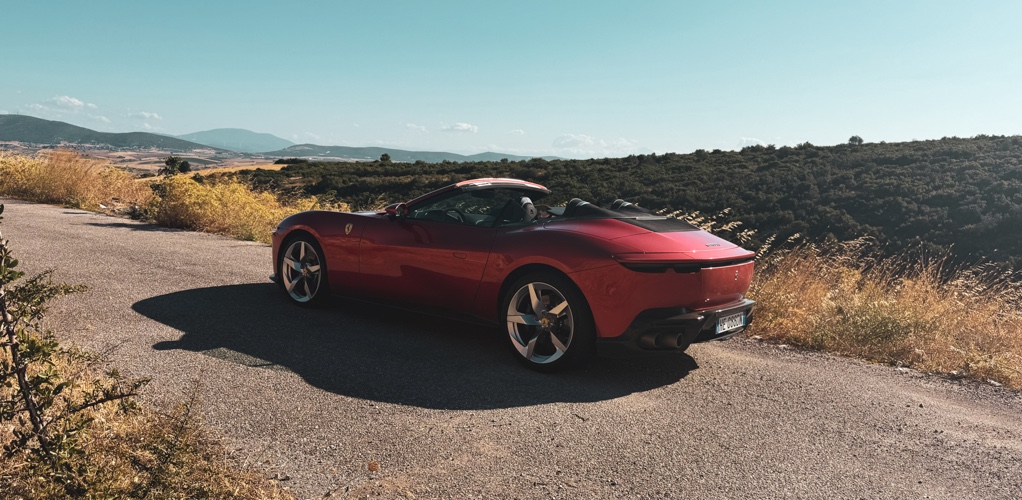
Replacing the Roma, the Amalfi likewise comes in two flavours. Coupe and what we were presented with here, the Spider. Whilst to the untrained eye it may bear a significant resemblance to its outgoing forebear, a more nuanced glance reveals the current model lineup replicated throughout in both form and function. As a swift introduction, the Amalfi sits at the far left of the spectrum of cars on offer from Maranello. Far left is the most road-focused and some would say, compliant, or in slightly more nineties vernacular, the junior model. Now, to put even that into further perspective, the Amalfi puts out 640CV. That is only 20CV below the iconic Enzo. Oh, how times have changed in twenty-odd years. The breadth of their offering is important to Ferrari, and we are told that the Amalfi represents the meeting point of performance, versatility and style. We sound like a match already.
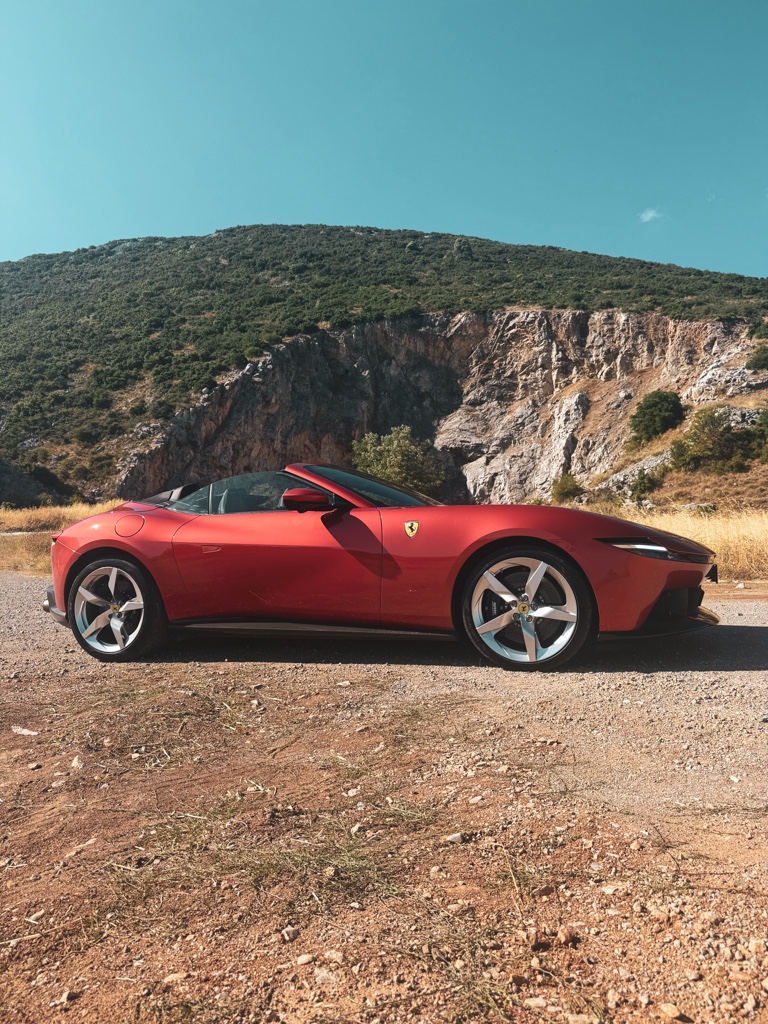
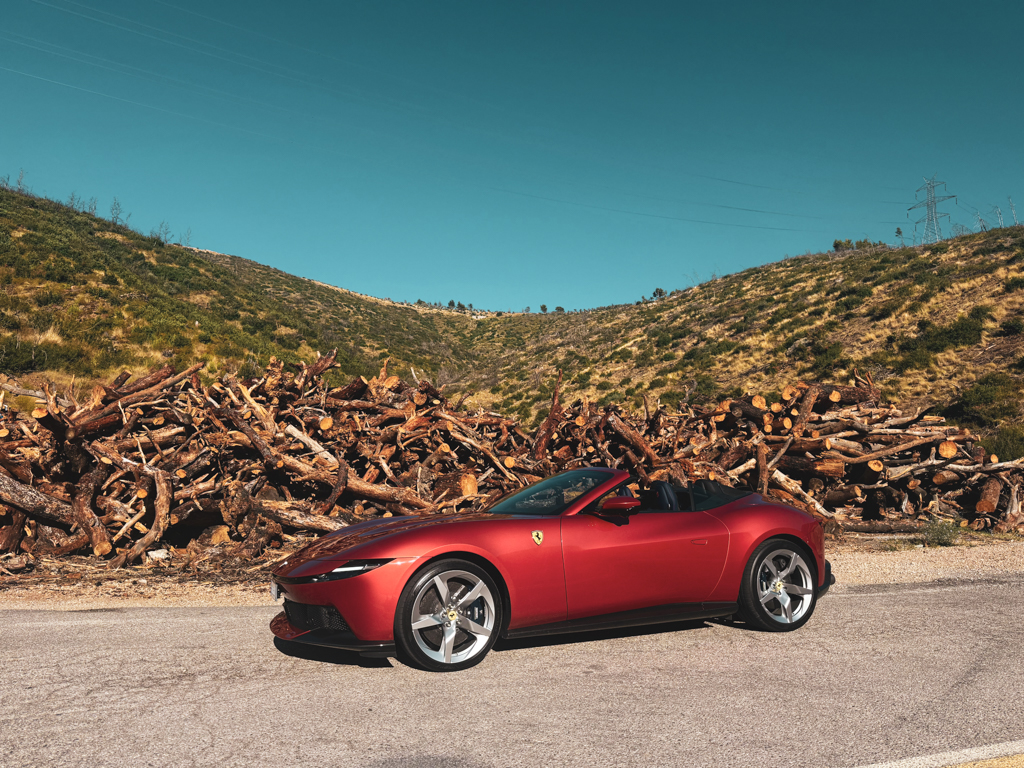
There is a way to describe the car and the trip and the details in such Steinbeck levels of care and attention, but we would be here for three volumes or more. So, as a quick rundown of the cold, hard facts, in addition to the one above. Aerodynamic design was hugely important in its development. CFD simulations. Wind tunnel testing and traditional design were all combined for aerodynamic gains. A variable geometry rear wing is introduced, with three different configurations. An innovation designed from scratch. The wing deploys from flush, the low-drag position, to medium downforce at 20% angle and high downforce at nearly 50%. 250 kph, the wing produces 110kg more downforce in high than in low. Management logic systems control its deployment. A new diffuser has been introduced, and with the rear lights now being concealed, a high rear three-quarter gives an unmistakable wedge shape; the Amalfi cuts a sculpted dash and shares only a handful of exterior and interior parts from the Roma. Almost every piece is new. Even the wheels, the scalloped five spoke using contrasting negative and positive spaces give a sense of movement even when static.
In spider guise, the profile with roof up is almost identical to the coupe. And five layers of insulation mean that the acoustic performance is akin to that of the coupe. There is an integrated wind deflector aimed at reducing road and wind noise at speed. The rear seat back pivots to horizontal at 101 degrees and can actually be deployed at up to 170kph. One thing that we have been consistently reminded of is that performance and usability are key elements for the Amalfi. The F154 family of engines have produced this twin-turbo V8. There is increased turbo spool with each bank running up to 171,000rpm and remaining equal. Through the use of a lightened camshaft and other internal elements, each bank has weight reduced by 2.5kg. Unlike many new models in the range, the Amalfi does not make use of any electrical additions to the drivetrain and that pure ICE propulsion is also placed front and centre, as the silencer has been adjusted to provide the best aural representation of that singing V8. All of this combines in that quoted 640CV at 7500rpm and means that the Amalfi spider will run to 100kph in just 3.3 seconds and will do the run to 200kph in just 9.3 seconds.
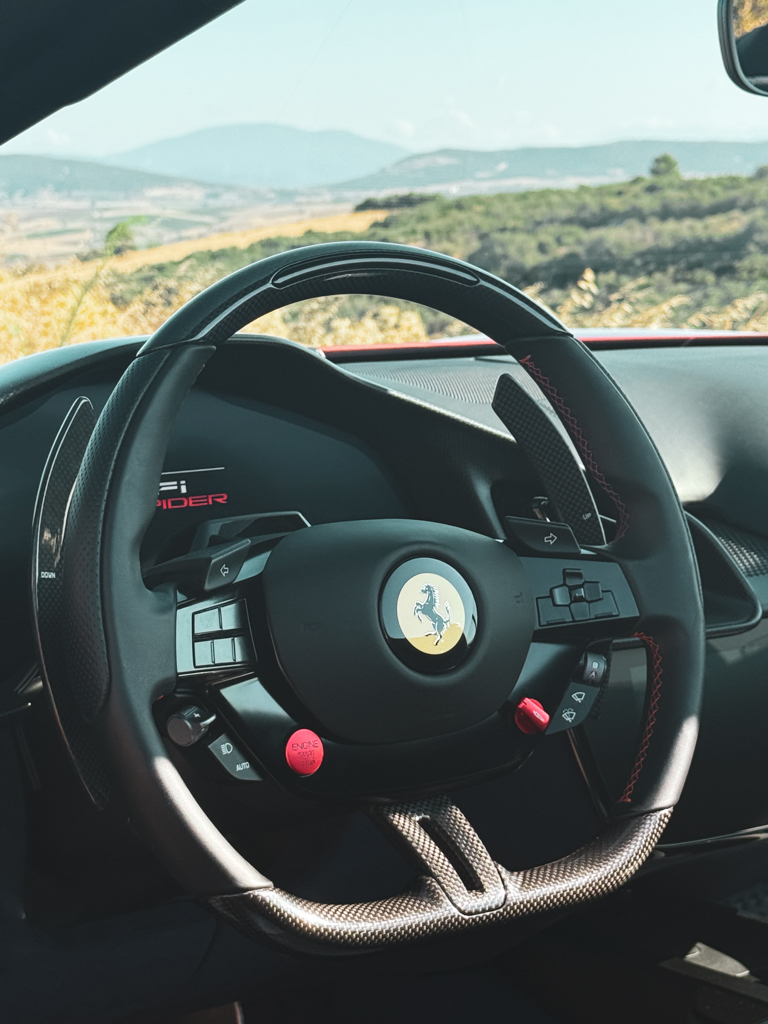
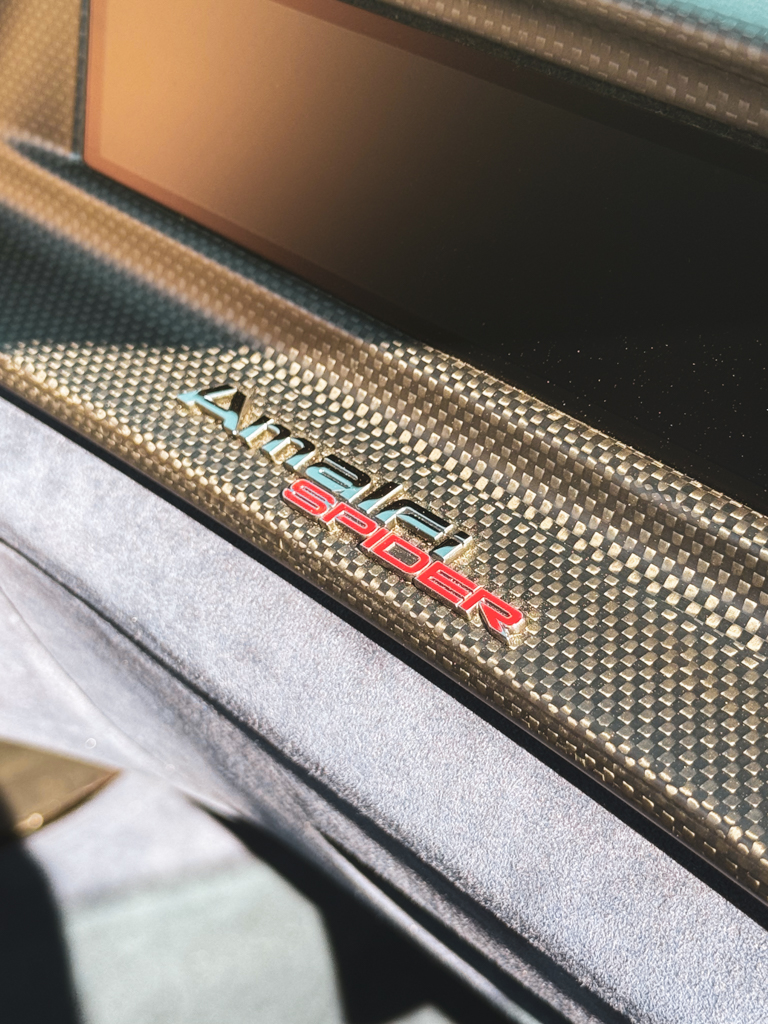
Inside, we see the progression or reversion of the Ferrari interior. With the wildly impactful, er’hem, cough, cough, launch of the Luce. A major element of interest was an all-new interior cockpit design. Whilst this is not that, it does feature many features missing on previous models and aligns with many seen on the new range. The dual cockpit design is one such consistent feature seen on the range. Two distinct areas internally mean that there is definition to the interior that makes it feel incredibly well resolved. The passenger display, or as I’ve previously called it, ‘the argument machine’, is as unintrusive as possible. In many other cars that have brought this display to their ranges, sometimes one doesn’t need a wildly bright display teasing the corner of one’s eye with Apple CarPlay. A large central screen provides the buffer between the two zones and the driver now has physical buttons with which to make adjustments. I read a BBC article recently that said the youth were returning to wired headphones and digital cameras. If we leave it long enough, maybe next year we will return to choke start. I jest; the return of buttons could not be more welcome. There are new Manettino setting maps from Wet, Comfort, and Sport through to Race; each brings a new dynamic. Compared to the Roma, whilst Comfort settings are very similar, the performance seen in the Amalfi in both Sport and Race exceeds that of the Roma by a significant margin. The largest improvement, as I will find out, is in the braking system and the new brake-by-wire system. There is improved pedal feel, shorter pedal travel and more linear returns. The new iteration of the ABS Evo System 6 allows for a more accurate wheel-speed reading, which in turn leads to precise braking. This, combined with the Side Slip Control 5.1, the twin vortex generators at the front and the new management logic systems controlling deployments across the car, promised to be a spanking good ride.
Morning came and after my requisite seven espressos and bite of a croissant, the breakfast of kings, we alighted to the hotel’s forecourt. Our route was some 181km for a scheduled four hours to allow those who film to film, and for those that don’t, to hoon. We departed the hotel in a vaguely staggered start, determined by each driver’s breakfast routine, I suspect. Quickly out of town and onto 30km of motorway, it gave me a chance to acclimatise and familiarise myself once again with the Ferrari DNA.
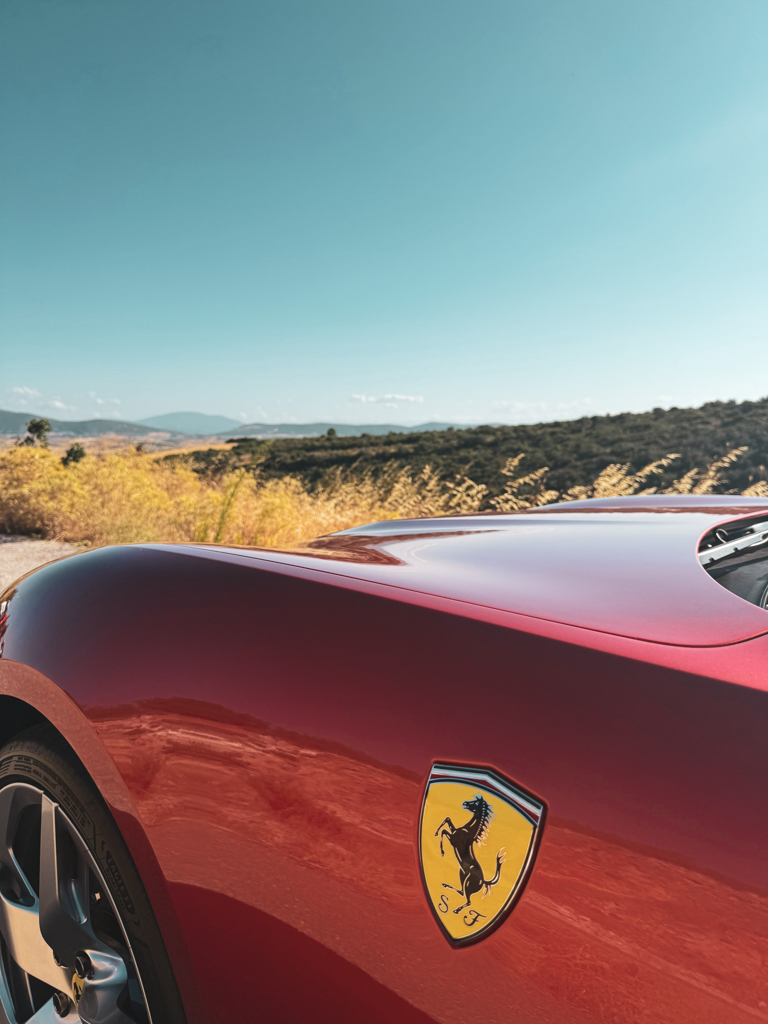
It’s interesting, as I said at the head of this piece, not in Amalfi, but in Greece. Off the motorway and into the Greek hills, I quickly realised the first part of this winding odyssey needed to be taken sedately at best, and this was made apparent at the infotainment screen screaming perilous drop and at one point, I am almost sure, I saw the words grave danger. Anyway, taking in the views and the various damper settings for the first half hour was nowt but a thing. A stop was scheduled atop the mountain. I say mountain, perhaps very big hill is a better descriptor, but eminently less cinematic. So, some of the pictures seen here were taken. Poses were posed, and I returned to come back down said mountain, on a route with none of the cliffside peril of the initial portion. The hoon was about to commence.
Being the furthest left on the org chart as discussed previously, the name of the game for the Amalfi Spider is predictability and usability. When an errant back end surprised me early in the drive, that it was so easy to sweep up and continue gave me confidence for the 160-odd additional km to go. It didn’t, however, make me a foolhardy guest and as I said, the climb up the mountain was as sedate as, admittedly, an open-top Ferrari can be. The journey down the mountain was glorious. For me, for the hills, for the wildlife, for the three or four locals that I despatched with ease. Race and Sport are certainly punchier than they have ever been at this end of the range, and a now near standard set up seems to win out, that being Sport or Race and damper set to comfort. As this was a media drive and I’m not stupid, my combination choice was Sport and Comfort, and traction stayed firmly in the ‘on’ position. It is a lithe car to move through the twisty stuff with a relatively short wheelbase; the car pivots extremely well and the drivetrain response ensures that with the grip elements such as Side Slip Control 5.1, the Amalfi Spider will gain traction and fire one off into the hills in the distance. It felt every bit as quick as the numbers would suggest and on the few pin-straight moments of the drive the Amalfi Spider pulled and pulled and pulled, as far as my, post motorcycle accident, tender balls would allow. To cap off those straights, one is presented with prodigious brakes. With such feel and consistency, they impart a real sense of assuredness and complement the myriad other skills that the Amalfi has.
So enjoyable was the drive that when I found myself WAY ahead of the game in terms of return time, I stopped at a roadside café and enjoyed an additional coffee or two. Not that I needed any supplement to the adrenaline, but more to allow myself to reflect, stare and let it wash over me somewhat. On the latter part of the journey, we returned via the motorway that we had driven in the early part of the route. If my memory served me correctly, that gave me three, maybe four tunnels with which to give those newly tuned silencers a chance to sing. In an age of stringent noise and pollution restrictions, it’s a wonder that they have managed to achieve such a sonorous soundtrack to the drivetrain, and it reverberates off the tunnel walls as little else in the automotive world can do.
So, what of an entry-level Ferrari? Well, I guess it’s the perfect entry point into the brand. Tactile, pretty, usable. All things are key to buyers both new and old. A huge new range of colour and texture combinations is possible, and it is easy to see that the entry-level car still represents something extremely personal and of exquisite quality. One can see how a lifetime with the brand could progress for them, should this, the Amalfi Spider, be their first purchase from Ferrari. At the start of our presentation, we were told, ‘Simplicity is complexity resolved’, and I couldn’t think of a better tagline for the car.