The autumn flagship cycle is under way, with Apple’s iPhone 18 Pro Max announced on September 9th and on sale from the 18th. Qualcomm’s new 2nm Snapdragon 8 Elite Gen 6 followed within days, and the Android phones built on it will arrive in weeks. Samsung’s Galaxy S26 Ultra has had six months in the wild to win over its new users, however. That makes this the one point in the year when the newest silicon, last year’s flagships and a deep pool of refurbished stock all compete for the same money. Black Friday, like most sales, rewards the buyer who does their research. So, should one go SIM-free, pile in with the new wave of products and features, or aim for that tide of trade-ins that rises every time a new model lands, carrying last season’s flagships back to market with most of their performance and less of their price?
Firstly, the case for going SIM-free
There is a strong financial case for buying a phone outright rather than through a contract. There are also data security concerns for some of our readers. A SIM-free refurbished handset leaves you free to pair it with a SIM-only tariff, which is usually much cheaper per month than an equivalent bundle. No hidden terms, no small print, just a price.
So what are the best Black Friday phone deals? For the networks, Black Friday promotions lean heavily on long-term commitments to make their headline figures work. Being tied into a contract for 24 months is a sizeable term, especially if you need wide-reaching international tech support. If you want an effective saving, the iPhone 16, 15 Pro and 15 Pro Max are tested, graded and sold at a considerable reduction from their original RRP at Back Market, an online marketplace dedicated to refurbished electronics.
Two flagships, two philosophies
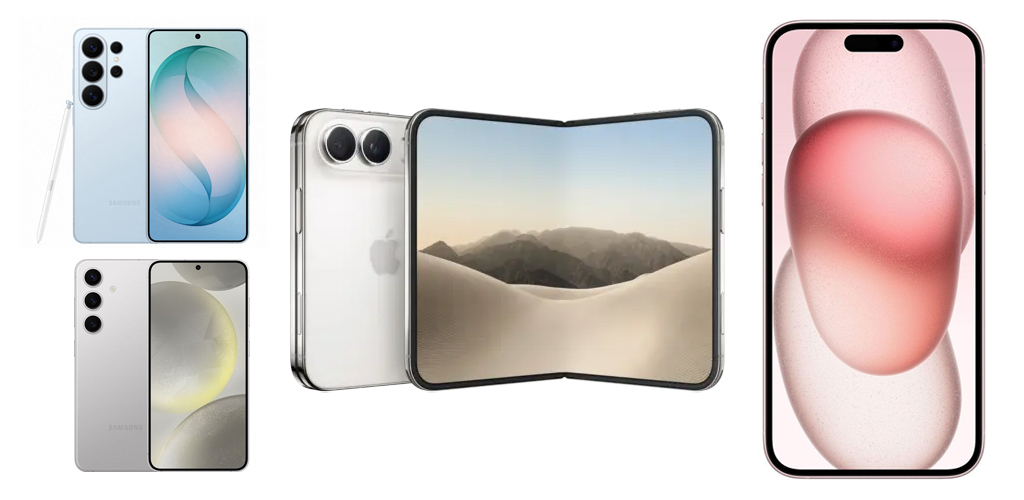
Apple has rebuilt the core of the iPhone this year: a new 2nm chip, its own cellular modem and wireless chip, and the first variable-aperture main camera on an iPhone. Samsung’s S26 Ultra is a more incremental release, refining a proven formula with a faster Qualcomm chip, quicker charging and some clever display tricks, and leaning on software for most of the headline features. Both phones use a 6.9in display and cost well north of £1,000 new, but they are built on very different priorities.
Silicon: A20 Pro vs Snapdragon 8 Elite Gen 5
The A20 Pro is Apple’s first chip built on a 2nm-class process. It keeps a six-core CPU layout (two performance cores and four efficiency cores), now with neural accelerators built into the CPU. Apple claims the seven-core GPU is up to 40% faster than the A19 Pro’s, that the dual 16-core Neural Engine doubles on-device AI throughput, and that memory bandwidth is up by 50%. It is paired with 12GB of RAM, which matters more than it used to now that Apple Intelligence and the new Siri run their models locally.
Samsung uses Qualcomm’s Snapdragon 8 Elite Gen 5 with the Adreno 840 GPU. The 256GB and 512GB models get 12GB of RAM, and the 1TB model gets 16GB. In day-to-day use, the two are closely matched. Apple’s advantage shows most in single-threaded work and power efficiency, while the Snapdragon is very strong in sustained GPU loads such as gaming and video exports.
Pros: the A20 Pro is ahead on process node, efficiency and on-device AI, and the 16GB option on the S26 Ultra suits heavy multitaskers.
Cons: most everyday apps will not use either chip’s extra headroom for some time. The benchmark gap is real, but will you really feel it?
Connectivity: Apple goes in-house
The iPhone 18 Pro Max is the first Pro iPhone to use Apple’s own connectivity chips throughout. The C2 modem replaces Qualcomm’s modems, and Apple says it uses 15 per cent less energy than the C1X. The N1 chip handles Wi-Fi 7, Bluetooth 6 and Thread. The S26 Ultra stays with Qualcomm’s mature modem platform, which has a long track record across networks and in weak-signal areas.
Pros: Apple’s approach should pay off in battery life and closer hardware and software integration.
Cons: this is a young modem family on its first Pro-tier outing, so early adopters are in effect testing it in the field. Buyers who rely on marginal signal may prefer to wait for independent testing.
Displays
The iPhone’s 6.9in LTPO OLED runs at 1320 x 2868 (about 460ppi) with a 120Hz ceiling and up to 3,000 nits outdoors. Samsung’s panel has a higher resolution at 1440 x 3120 and a quoted peak of 2,600 nits. It adds an effective anti-reflective coating and a new Privacy Display mode, which narrows viewing angles at the hardware level.
Pros: the Samsung screen is sharper and noticeably easier to read in sunlight. Apple’s panel is brighter at its peak, with strong colour management.
Cons: the S26 Ultra still uses an 8-bit panel without high-frequency PWM dimming, which matters to anyone sensitive to flicker at low brightness. But otherwise, very tough to fault!
Cameras
This is where the two philosophies differ most. The iPhone 18 Pro Max uses three 48MP cameras: a new main sensor with a variable aperture from f/1.5 to f/4 (controlled by six physical blades), a 100mm-equivalent 4x periscope telephoto and an ultra-wide. Video supports 4K at up to 120fps, ProRes RAW and Dolby Vision HDR, and the 18MP front camera uses the square sensor Apple introduced last year. Can they be far away from a consumer or even prosumer range of cameras?
Samsung uses a 200MP f/1.4 main camera, a 50MP 5x periscope, a 10MP 3x telephoto and a 50MP ultra-wide, with a 12MP selfie camera.
Pros: the iPhone’s variable aperture gives real optical depth-of-field control and sharper close-ups, and its video pipeline is still the professional benchmark. Samsung’s four-lens layout covers more focal lengths, and its 200MP sensor keeps a lot of detail when you crop.
Cons: Samsung’s image processing can over-sharpen, and its 10MP 3x lens is now the weakest camera in either phone. Apple’s single 4x telephoto leaves a gap between 1x and 4x that the crop mode only partly fills.
Battery, charging and weight
Apple quotes up to 45 hours of video playback for the eSIM-only Pro Max and says it charges to 50 per cent in about 15 minutes over a cable. That endurance means weight: at 249g and 8.8mm thick, it is the heaviest Pro Max yet. The S26 Ultra has a 5,000mAh cell with 60W wired and 25W wireless charging, and it is much lighter at 214g and 7.9mm.
Pros: the iPhone has class-leading endurance, while the Samsung is lighter and charges faster over a cable.
Cons: the iPhone is heavy enough to notice at the end of a long day. The Samsung still has no built-in Qi2 magnets, so magnetic accessories need a case.
The Details
| iPhone 18 Pro Max | Galaxy S26 Ultra | iPhone 17 Pro Max | |
|---|---|---|---|
| Chip | A20 Pro (2nm) | Snapdragon 8 Elite Gen 5 | A19 Pro |
| RAM | 12GB | 12GB / 16GB (1TB) | 12GB |
| Display | 6.9in OLED, 120Hz, up to 3,000 nits | 6.9in QHD+ AMOLED, 120Hz, 2,600 nits, Privacy Display | 6.9in OLED, 120Hz, up to 3,000 nits |
| Main camera | 48MP, f/1.5–f/4 variable | 200MP, f/1.4 | 48MP |
| Telephoto | 48MP 4x periscope | 50MP 5x + 10MP 3x | 48MP 4x tetraprism |
| Modem | Apple C2 | Qualcomm | Qualcomm |
| Weight | 249g | 214g | 231g |
| Released | September 2026 | March 2026 | September 2025 |
The argument for a thoughtful iPhone upgrade
The iPhone 17 Pro Max already has 12GB of RAM, three 48MP rear cameras including a 4x tetraprism telephoto, the 18MP square-sensor front camera, a 3,000-nit display and the aluminium unibody with an internal vapour chamber that transformed sustained performance last year. Moving to the 18 Pro Max adds the variable aperture, the 2nm A20 Pro and the C2 modem. Those are real gains, but they are small next to the gap in price.
The iPhone 16 Pro and 15 Pro Max carry the argument further down the range. Both have titanium frames, USB-C and support for Apple Intelligence, so neither is left behind on software.
The Galaxy line keeps its competitive edge
On the Android side, the gap between generations is narrower still. The Galaxy S25 Ultra has the same 200MP main camera, the same 50MP 5x periscope and the same 5,000mAh battery as its successor. It runs on the Snapdragon 8 Elite for Galaxy, a chip that is still well above what current apps demand. A refurbished S25 Ultra misses out on the Privacy Display, 60W charging and a modest increase in chip performance, and not much else. Samsung’s seven-year OS and security update commitment also means a 2025 Ultra has software support well into the next decade.
The Galaxy S24 Ultra is a step further back and makes the same case at a lower price. Its main compromise is the older Snapdragon 8 Gen 3, which is still more than capable for photography and everyday use.
The verdict
iPhone 18 Pro Max: buy it for the best video capture on any phone, class-leading battery life and the most advanced silicon available. Its drawbacks are weight, a brand-new modem about to be mass tested and a launch price that Black Friday will barely move.
Galaxy S26 Ultra: buy it for the sharpest, most readable screen, the most flexible zoom range and 60W charging in a much lighter body. Its drawbacks are an incremental hardware update, an ageing 3x lens and no built-in magnets.
Refurbished iPhone 17 Pro Max or Galaxy S25 Ultra: buy one for about nine-tenths of the current flagship experience, with years of software support still to come. You give up the few features that are new this year.